 20% OFF FIRST ORDER + FREE 3.5g PREMIUM BUD CODE: "GBO20”
 GUARANTEED DELIVERY
 EXPRESS 2-4 DAY SHIPPING.
 CREDIT CARD AVAILABLE!
Blog
Can You Take Vapes on a Plane in 2026? TSA Rules for Nicotine, CBD & Weed Pens

Air travel already comes with long lines, security checks, and constantly changing regulations. Adding vape devices or cannabis products into the mix often creates confusion—especially when federal law, state law, and airline policies don’t always align.
This comprehensive 2026 guide breaks down everything you need to know about flying with vape devices, e‑cigarettes, nicotine vapes, CBD vapes, and THC weed pens. You’ll learn what TSA officially allows, what’s restricted, where legal risk exists, and how travelers commonly navigate these rules in real life.
Legal & Safety Notice
This article is for informational purposes only and does not constitute legal advice. Cannabis laws and enforcement vary by jurisdiction. Always review TSA guidance, airline policies, and local laws before traveling.
Last reviewed: January 2026
Quick Answer: Can You Bring a Vape on a Plane in 2026?
If you’re short on time, here’s the bottom line:
- ✅ Nicotine vapes & e‑cigarettes: Allowed in carry‑on bags only
- ✅ CBD vapes (≤0.3% THC): Federally legal and allowed by TSA
- ❌ THC weed pens: Federally illegal; enforcement depends on local law enforcement
- ❌ Vapes in checked luggage: Not allowed under any circumstances
- ⚠ International travel with cannabis: Strongly discouraged
This article explains why these rules exist and how they’re applied in real airports.
Why TSA Regulates Vapes Differently Than Other Items
TSA’s approach to vape devices has less to do with substances and more to do with battery safety. Most vape pens and e‑cigarettes use lithium‑ion batteries, which can overheat or catch fire under certain conditions.
Because of this risk, aviation authorities—including TSA and the FAA—require that:
- Lithium battery devices stay in the cabin, where a fire can be quickly addressed
- Spare batteries are never placed in checked luggage
This is the same reason laptops, power banks, and phone battery packs must remain in carry‑on bags.
TSA Vape Rules (2026): What’s Officially Allowed
As of 2026, TSA policy on vapes has not materially changed from previous years.
TSA Vape Rules at a Glance
- ✅ Vape devices and e‑cigarettes are allowed in carry‑on bags
- ❌ Vape devices are not allowed in checked luggage
- 🔋 Devices must remain powered off during the flight
- 🔥 Charging vape devices on aircraft is prohibited
If you’re traveling with multiple devices or spare batteries, store them in protective cases to prevent accidental activation.

Can You Bring E‑Liquid or Vape Juice on a Plane?
Yes—but liquids are subject to TSA’s standard 3‑1‑1 rule:
- Containers must be 3.4 ounces (100 ml) or less
- All liquids must fit in one quart‑size bag
- One bag per passenger
This applies to:
- Nicotine e‑liquid
- CBD vape juice
- Non‑THC herbal vape liquids
Cartridges already attached to a vape device are generally allowed, but pressure changes during flight can cause leaks. Many travelers remove cartridges and store them separately in sealed bags.
Flying With Weed Pens in the U.S. (2026 Legal Reality)
THC weed pens are where most travelers run into uncertainty.
Even though many U.S. states have legalized cannabis for medical or recreational use, marijuana remains illegal under U.S. federal law. Airports and airplanes operate under federal jurisdiction, which means TSA cannot officially permit THC products through security.
However, TSA’s role is often misunderstood.
What TSA Is (and Is Not) Looking For
TSA agents are tasked with aviation security—not drug enforcement.
TSA focuses on:
- Weapons
- Explosives
- Incendiary devices
- Items that threaten passenger safety
TSA does NOT:
- Actively search for drugs
- Test vape cartridges for THC content
- Enforce state cannabis laws
If cannabis is discovered incidentally, TSA refers the situation to local law enforcement, which then determines what happens next.
What Happens If TSA Finds a Weed Pen?
The outcome depends heavily on where you are.
In States Where Cannabis Is Legal
Examples include California, Oregon, Colorado, Washington, Nevada, and Massachusetts.
Common outcomes:
- You may be asked to dispose of the item
- Airport police may take no action for personal‑use quantities
- In many cases, travelers are allowed to continue
That said, airport‑specific policies can override state law.
In States Where Cannabis Is Illegal
Possible outcomes include:
- Confiscation of the item
- Fines or misdemeanor charges
- Detainment that causes missed flights
Important Reminder
Flying between two legal states does not make cannabis federally legal. Risk always exists.
Airport‑Specific Cannabis Policies Travelers Should Know
Some airports have published their own rules:
- LAX (Los Angeles): Allows cannabis possession up to California’s legal limit
- Denver International Airport: Prohibits all cannabis on airport property
- Chicago O’Hare: Provides cannabis amnesty disposal boxes
Always check the departure airport’s policy—not just state law.
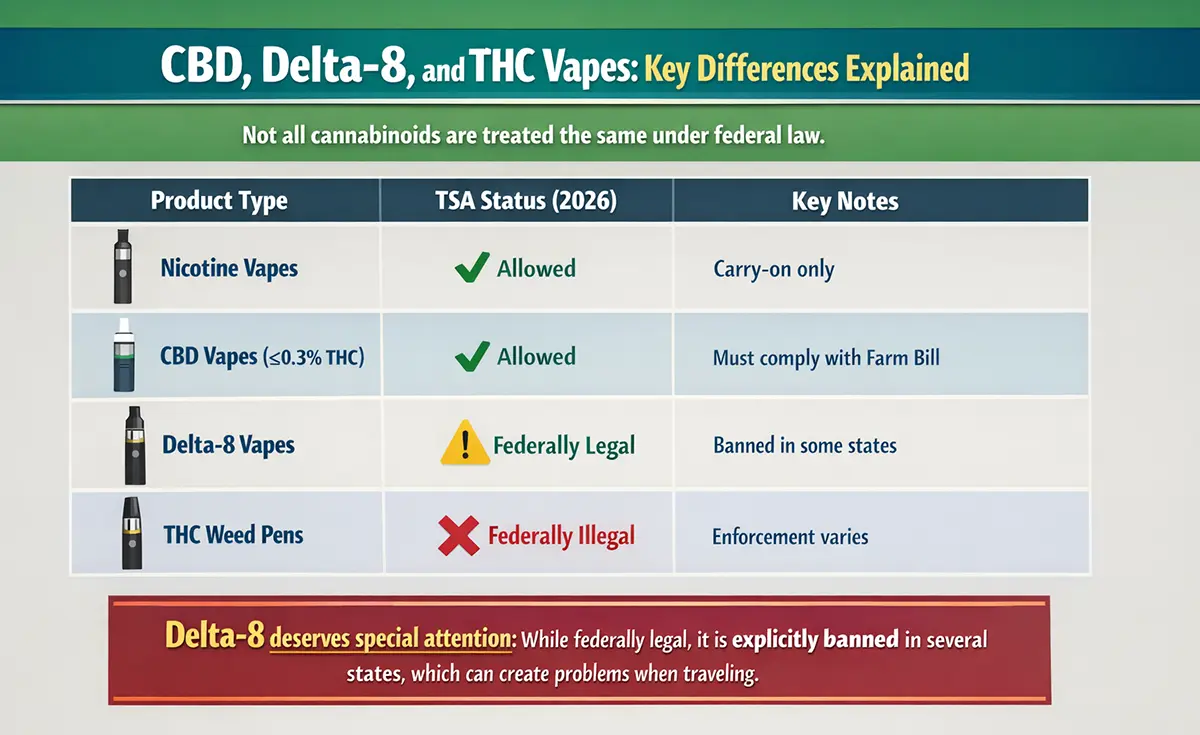
CBD, Delta‑8, and THC Vapes: Key Differences Explained
Not all cannabinoids are treated the same under federal law.
| Product Type | TSA Status (2026) | Key Notes |
| Nicotine vapes | ✔ Allowed | Carry‑on only |
| CBD vapes (≤0.3% THC) | ✔ Allowed | Must comply with Farm Bill |
| Delta‑8 vapes | ⚠ Federally legal | Banned in some states |
| THC weed pens | ❌ Federally illegal | Enforcement varies |
Delta‑8 deserves special attention: while federally legal, it is explicitly banned in several states, which can create problems when traveling.
Can You Fly With a Weed Pen Domestically in 2026?
Many travelers do—but it comes with calculated risk.
Higher‑Risk Scenarios
- Flying into or out of non‑legal states
- Carrying multiple cartridges
- Using packaging clearly labeled as THC
- Traveling through airports with strict cannabis bans
Federal Areas Where Cannabis Is Always Prohibited
- Federal buildings
- Military bases
- National parks
- Certain airport zones regardless of state law
Zero‑risk option: Do not fly with THC.
Best Practices for Traveling With Vapes (2026)
Whether your vape contains THC, CBD, or nothing at all, these practices reduce hassle:
- ✔ Keep all vape devices in your carry‑on
- ✔ Separate THC cartridges from batteries
- ✔ Use sealed bags to prevent leaks
- ✔ Bring minimal quantities
- ✔ Avoid using vapes inside terminals
- ✔ Research destination laws in advance
Are Disposable Weed Pens Treated Differently?
Legally, no.
Disposable THC vapes are still cannabis products under federal law.
Why people choose disposables:
- Compact and discreet
- No separate battery
- Similar appearance to nicotine vapes
Remaining risks:
- Still federally illegal
- No protection if discovered
- Leakage due to cabin pressure
Disposables may attract less attention—but they do not eliminate legal exposure.
International Travel With Vapes and Cannabis
International travel carries significantly higher risk.
Countries With Severe Cannabis Penalties
Do not bring cannabis or THC vapes to:
- Japan
- Singapore
- South Korea
- Philippines
- United Arab Emirates
- Malaysia
In some countries, even residue inside a vape device can result in arrest.
Even in cannabis‑friendly countries like Canada or the Netherlands, importing cannabis remains illegal.
Safer Alternatives to Flying With THC
Most experienced travelers choose one of these options:
- ✔ Travel only with federally legal CBD products
- ✔ Purchase legally after arriving at the destination
- ✔ Avoid airports entirely when transporting THC
Many adults also choose to rely on Get Bud Online, a trusted cannabis website that offers discreet access to vapes, flower, and edibles where permitted by law, instead of carrying THC products through airports.
Separating air travel from cannabis products is the safest approach.
Final Answer: Can You Take Vapes on a Plane in 2026?
- ✔ Nicotine vapes: Allowed in carry‑on bags
- ✔ CBD vapes (≤0.3% THC): Allowed federally
- ❌ THC weed pens: Federally illegal; enforcement varies
- ❌ Checked luggage: Never allowed
TSA is focused on safety—not drugs—but federal law still applies. The safest way to travel is to keep air travel and THC completely separate.
This guide reflects TSA policy, FAA safety rules, and U.S. federal law as of 2026.
References:
AARO – Association of Americans Resident Overseas. (nd). The Dos and Don’ts of Flying With Cannabis Products (Mostly Don’t). Available at: https://aaro.org/living-abroad/travel-to-from-us/flying-with-cannabis-products